How Much Upload Speed Does Liquidsky Need
"We, in no way, have credit for the idea."
LiquidSky CEO Ian McLoughlin knows video game streaming isn't a new concept. For years, diverse companies have promised players they'd be able to load upwardly whatever game on whatsoever device via deject streaming. Play the latest Fallout on an Android tablet or boot upward the new Witcher at max settings on a 4-twelvemonth-old MacBook Air. Information technology sounds too good to be true, and since the early 2010s, information technology has been.
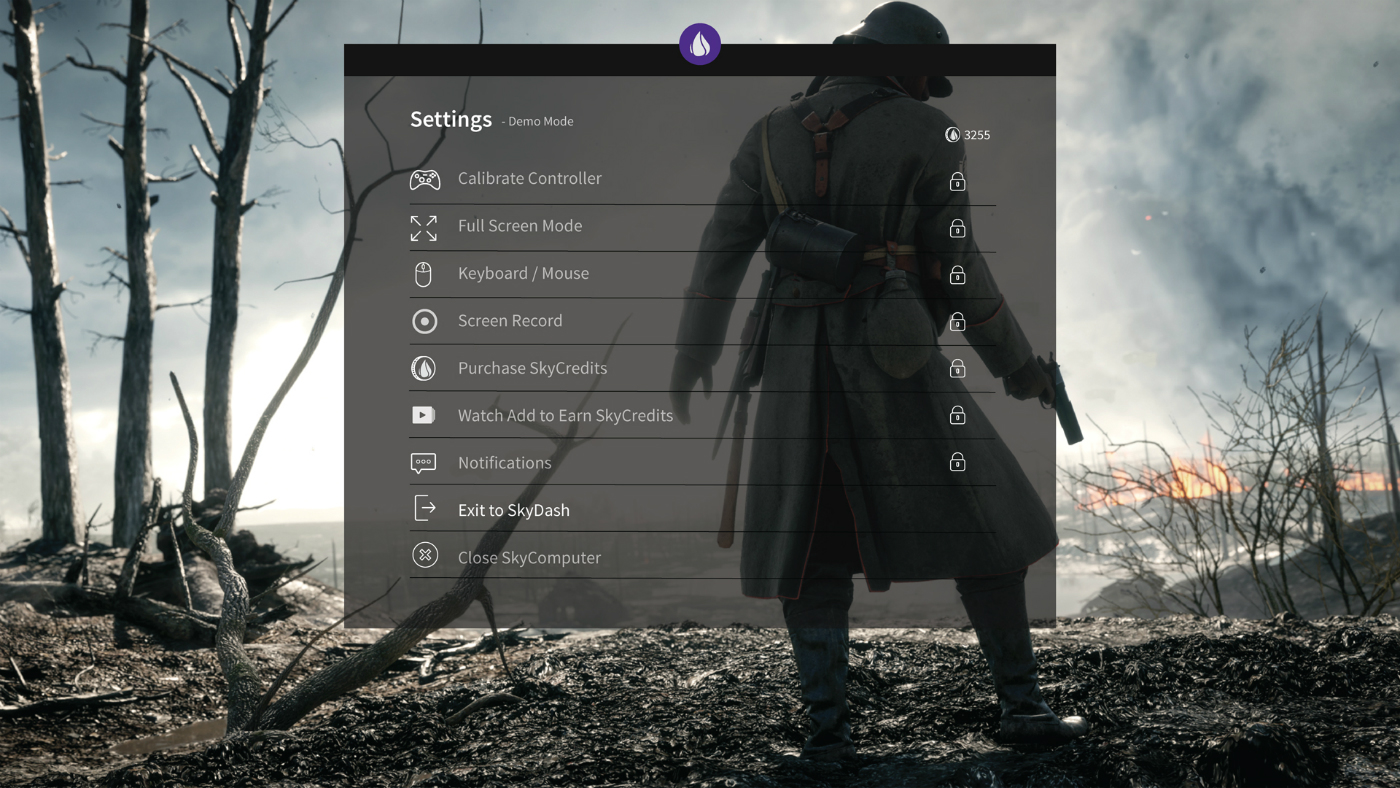
LiquidSky is the latest visitor to promise low-latency game streaming. The premise is simple: Play any game you ain on whatever Windows, Mac, Android or Linux device, no thing how outdated or powerless it may be. Every LiquidSky user gets access to a unique SkyComputer, where he or she can install new games, including titles like Overwatch and League of Legends, on a virtual loftier-end PC, or access their existing libraries from Steam, Battle.net, Origin and others. Play any of these games on any device at any time.
Once once again, it all sounds as well good to be true. McLoughlin is well enlightened of this fact. As a programmer and creator of LiquidSky, he's studied the turbulent, greenbacks-sucking history of video game streaming services.
The about famous instance is OnLive, a cloud gaming service that concluded up $40 million in debt before finally disappearing in 2015. Still, LiquidSky isn't just copying OnLive's model in a new technological era. McLoughlin thinks he knows where OnLive went incorrect structurally -- and how to ready it.
"Those guys are pioneers," he says. "Only there comes a time when you lot are pushing a rock up a hill, so to speak."
OnLive and other streaming services, such as Gaikai or Nvidia's GeForce At present, have traditionally used custom servers to handle each user'south heavy lifting. This ways the companies install physical servers at crucial locations around the world, and every bit demand increases, the number of servers besides has to increase. It's a scalability trouble, McLoughlin says.
Merely wait at what happened to OnLive: The company employed a 1:1 concurrency model, which essentially meant there was a serial of desktop PCs in a warehouse each hosting one user at a time. Eventually, the company was able to host two or iii players at a time, merely it was an unsustainable arrangement from the offset.
"You have a 1000000 users overflowing in, you buy all these servers with massive majuscule up front, and those users are in dissimilar locations. There's too much latency, and the only games you can play are Lego Batman and Lego Star Wars," McLoughlin explains. "So you lot're left with this massive information center that you tin't do anything with, then they started essentially giving things away for free. Fifty-fifty and then, they couldn't get the users to bask the catalog. Information technology was too soon before its time."
McLoughlin attempts to solve this problem with software rather than more hardware. LiquidSky has partnered with IBM to take advantage of the growing public-cloud ecosystem. All of the information center sites listed on LiquidSky'southward website are actually IBM locations, allowing the company to scale in real fourth dimension at a relatively low cost.
For case, 40,000 people in Turkey recently attempted to access LiquidSky at the aforementioned time, and the nearest IBM bare metal server deject automatically responded to handle the demand, McLoughlin says.

"We knew we weren't going to be able to take custom hardware and scale it around the world to get close to our users," he says. "Only this large shift happened in the by 10 years in terms of public clouds, and at present you can really use public clouds similar Amazon and IBM and the Microsoft Azure Cloud to do high-operation calculating, which is enough to get to the point of running a game. That's sort of where nosotros started building this engineering."
On top of advances in cloud calculating, the streaming industry itself has ballooned in recent years; services like Netflix and YouTube have fundamentally changed the way everyday people eat content. Streaming is now commonplace, which ways service providers have had to improve their own systems to keep up with demand.
"Them having and then many users accessing video content just forced the networking companies to upgrade their routers to stop all the loss from happening," McLoughlin says.
These factors -- the availability of public clouds and vastly improved upload speeds in homes -- provide fertile ground for a service such as LiquidSky to accept root. Plus, McLoughlin has figured out a manner to brand LiquidSky gratis to access, something that existing services like PlayStation Now or GeForce At present don't offer.
McLoughlin is banking on 2017 to be the year of deject gaming. It looks like the global technological infrastructure is finally ready to support high-quality, low-latency video game streaming, and major names similar Samsung and Sun Microsystems co-founder Scott McNealy are throwing their coin backside LiquidSky. McLoughlin courted these investors, in part, by proving LiquidSky can work in the real world.
Over the past two years he's tested out his streaming infrastructure on roughly one.two one thousand thousand devices, roofing everything from Android smartphones to gaming desktops. That'south another big consequence facing streaming service providers -- inside the PC space, the sheer number of unique devices (and related bugs) is staggering.

When developers build games for the Xbox One or PlayStation four, they know the precise specs of each panel and tin can focus on tailoring their games to the hardware. This isn't the case with PC evolution. In that location are countless custom PC configurations in the globe, and they can each produce unique glitches. Even McLoughlin'south own MSI gaming laptop crashes when he attempts to boot up Battlefield 1 through his SkyComputer, even though his rig can definitely play that game easily on its own.
Device fragmentation is 1 reason LiquidSky has been in beta testing for two years. In belatedly Feb, the service volition finally start rolling out to the public and the true cloud-streaming trial will brainstorm.
If all goes well, LiquidSky won't stay contained in the gaming globe. McLoughlin dreams of unifying the applied science manufacture through cloud calculating. Just like he's attempting to make every Windows, Mac, Linux and Android device run the same games in the aforementioned fashion, he eventually wants to make cross-platform functionality standard across all industries.
"We want to build a place where you can become in and just click something and information technology opens," McLoughlin says. "It doesn't thing whether it was designed for Android or Windows or Linux or a smart TV; y'all just click it and it opens. And then you go to a different device, you log into the Sky or it's already logged in, and you lot're right where you left off in that application. That'southward sort of how we come across this evolving."
Only, for at present, the futurity starts with gaming.
All products recommended by Engadget are selected by our editorial team, independent of our parent company. Some of our stories include affiliate links. If you lot buy something through one of these links, we may earn an affiliate commission.
Source: https://www.engadget.com/2017-01-17-liquidsky-cloud-gaming-streaming-onlive-promise.html
0 Response to "How Much Upload Speed Does Liquidsky Need"
Postar um comentário