After Cytokinesis and Prophase Ii Did the Genetic Material Replicate Again?
Recap: What is Meiosis?
Meiosis is how eukaryotic cells (plants, animals, and fungi) reproduce sexually. It is a process of chromosomal reduction, which means that a diploid cell (this ways a jail cell with two complete and identical chromosome sets) is reduced to form haploid cells (these are cells with but i chromosome set). The haploid cells produced past meiosis are germ cells, also known as gametes, sexual practice cells or spores in plants and fungi. These are essential for sexual reproduction: two germ cells combine to class a diploid zygote, which grows to course some other functional developed of the same species.
The procedure of chromosomal reduction is important in the conservation of the chromosomal number of a species. If chromosome numbers were non reduced, and a diploid germ cell was produced past each parent, then the resulting offspring would accept a tetraploid chromosome set: that is, information technology would accept four identical sets of chromosomes. This number would continue increasing with each generation. This is why the chromosomal reduction is vital for the continuation of each species.
Meiosis occurs in ii distinct phases: meiosis I and meiosis II. There are many similarities and differences between these phases, with each phase producing dissimilar products and each phase being equally crucial to the production of feasible germ cells.
What Happens Before Meiosis?
Before meiosis, the chromosomes in the nucleus of the jail cell replicate to produce double the amount of chromosomal material. Afterward chromosomal replication, chromosomes separate into sis chromatids. This is known as interphase, and can be further broken down into two phases in the meiotic cycle: Growth (G), and Synthesis (South). During the G phase proteins and enzymes necessary for growth are synthesized, while during the S stage chromosomal material is doubled.
Meiosis is then split into ii phases: meiosis I and meiosis II. In each of these phases, there is a prophase, a metaphase, and anaphase and a telophase. In meiosis I these are known equally prophase I, metaphase I, anaphase I and telophase I, while in meiosis II they are known as prophase Two, metaphase Ii, anaphase II and telophase 2. Different products are formed by these phases, although the bones principles of each are the same. Also, meiosis I is preceded in interphase by both G phase and Southward phase, while meiosis II is just preceded by S phase: chromosomal replication is not necessary again.
The Phases of Meiosis I
Afterward Interphase I meiosis I occurs afterward Interphase I, where proteins are grown in G phase and chromosomes are replicated in S phase. Following this, 4 phases occur. Meiosis I is known equally reductive partitioning, equally the cells are reduced from existence diploid cells to being haploid cells.
1. Prophase I
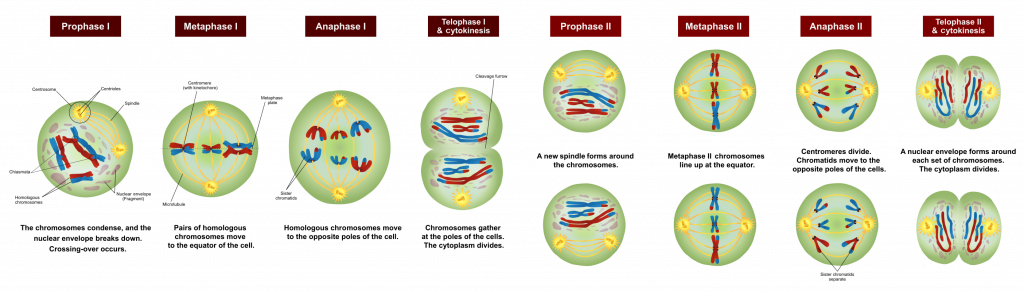
Prophase I is the longest stage of meiosis, with three chief events occurring. The first is the condensation of chromatin into chromosomes that can be seen through the microscope; the second is the synapsis or physical contact between homologous chromosomes; and the crossing over of genetic cloth between these synapsed chromosomes. These events occur in 5 sub-phases:
- Leptonema– The first prophase event occurs: chromatin condenses to grade visible chromosomes. Condensation and coiling of chromosomes occur.
- Zygonema– Chromosomes line upwards to course homologous pairs, in a process known equally the homology search. These pairs are besides known equally bivalents. Synapsis happens when the homologous pairs bring together. The synaptonemal complex forms.
- Pachynema– The third principal upshot of prophase I occurs: crossing over. Nonsister chromatids of homologous chromosome pairs exchange parts or segments. Chiasmata grade where these exchanges have occurred. Each chromosome is now different to its parent chromosome but contains the aforementioned amount of genetic textile.
- Diplonema– The synaptonemal complex dissolves and chromosome pairs begin to separate. The chromosomes uncoil slightly to allow DNA transcription.
- Diakinesis – Chromosome condensation is furthered. Homologous chromosomes separate further but are still joined by a chiasmata, which moves towards the ends of the chromatids in a procedure referred to equally terminalization. The nuclear envelope and nucleoli disintegrate, and the meiotic spindle begins to form. Microtubules attach to the chromosomes at the kinetochore of each sister chromatid.
2. Metaphase I
Homologous pairs of chromosomes align on the equatorial plane at the heart of the cell. Independent assortment determines the orientation of each bivalent merely ensures that half of each chromosome pair is oriented to each pole. This is to ensure that homologous chromosomes do not terminate up in the same cell. The arms of the sister chromatids are convergent.
iii. Anaphase I
Microtubules begin to shorten, pulling one chromosome of each homologous pair to reverse poles in a process known as disjunction. The sister chromatids of each chromosome stay connected. The cell begins to elongate in training for cytokinesis.
four. Telophase I
Meiosis I ends when the chromosomes of each homologous pair arrive at opposing poles of the cell. The microtubules disintegrate, and a new nuclear membrane forms effectually each haploid set of chromosomes. The chromosomes uncoil, forming chromatin again, and cytokinesis occurs, forming two non-identical daughter cells. A resting phase known as interkinesis or interphase II happens in some organisms.
The Phases of Meiosis II
Meiosis Ii may begin with interkinesis or interphase 2. This differs from interphase I in that no S phase occurs, every bit the Dna has already been replicated. Thus only a G phase occurs. Meiosis Two is known as equational sectionalisation, equally the cells begin equally haploid cells and terminate as haploid cells. There are again four phases in meiosis II: these differ slightly from those in meiosis I.
1. Prophase II
Chromatin condenses to form visible chromosomes again. The nuclear envelope and nucleolus disintegrate, and spindle fibers begin to appear. No crossing over occurs.
2. Metaphase II
Spindle fibers connect to the kinetochore of each sister chromatid. The chromosomes align at the equatorial airplane, which is rotated 90° compared to the equatorial plane in meiosis I. One sis chromatid faces each pole, with the artillery divergent.
3. Anaphase Ii
The spindle fibers connected to each sis chromatid shorten, pulling i sister chromatid to each pole. Sis chromatids are known equally sis chromosomes from this indicate.
four. Telophase Ii
Meiosis II ends when the sis chromosomes have reached opposing poles. The spindle disintegrates, and the chromosomes recoil, forming chromatin. A nuclear envelope forms around each haploid chromosome prepare, earlier cytokinesis occurs, forming 2 daughter cells from each parent prison cell, or four haploid girl cells in full.
Figure 1. The phases of meiosis I and meiosis II, showing the formation of four haploid cells from a single diploid cell.
How is Meiosis I Unlike from Meiosis Two?
Meiosis is the production of 4 genetically diverse haploid daughter cells from one diploid parent cell. Meiosis tin only occur in eukaryotic organisms. It is preceded by interphase, specifically the One thousand stage of interphase. Both Meiosis I and Two take the same number and arrangement of phases: prophase, metaphase, anaphase, and telophase. Both produce 2 daughter cells from each parent cell.
However, Meiosis I begins with ane diploid parent cell and ends with two haploid daughter cells, halving the number of chromosomes in each cell. Meiosis II starts with two haploid parent cells and ends with iv haploid daughter cells, maintaining the number of chromosomes in each cell. Homologous pairs of cells are present in meiosis I and split into chromosomes earlier meiosis II. In meiosis II, these chromosomes are further separated into sister chromatids. Meiosis I includes crossing over or recombination of genetic textile between chromosome pairs, while meiosis Two does not. This occurs in meiosis I in a long and complicated prophase I, split into five sub-phases. The equatorial plane in meiosis II is rotated xc° from the alignment of the equatorial plane in meiosis I.
The table below summarizes the similarities and differences betwixt meiosis I and meiosis Two.
Table 1. The similarities and differences between meiosis I and meiosis Two.
| Meiosis I | Meiosis Ii |
Similarities | |
| Can only occur in eukaryotes | |
| Chiliad phase of interphase usually occurs commencement | |
| Product of daughter cells based on parent prison cell's genetic material | |
| Means of sexual reproduction in plants, animals, and fungi | |
| Four phases occur: prophase, metaphase, anaphase, telophase | |
Differences | |
| Starts as diploid; ends as haploid | Starts as haploid; ends as haploid |
| Reductive segmentation | Equational division |
| Homologous chromosome pairs separate | Sis chromatids separate |
| Crossing over happens | Crossing over does non happen |
| Complicated division process | Simple division procedure |
| Long duration | Brusque duration |
| Preceded by Due south-phase and G-phase | Preceded only past G-phase |
| Sister chromatids in prophase take convergent artillery | Sister chromatids in prophase have divergent arms |
| Equatorial plane is centered | Equatorial aeroplane is rotated xc° |
| Prophase separate into v sub-phases | Prophase does not accept sub-phases |
| Ends with ii daughter cells | Ends with 4 daughter cells |
Why is Meiosis Of import?
Meiosis is essential for the sexual reproduction of eukaryotic organisms, the enabling of genetic diversity through recombination, and the repair of genetic defects.
The crossing over or recombination of genes occurring in prophase I of meiosis I is vital to the genetic diversity of a species. This provides a buffer confronting genetic defects, susceptibility to affliction and survival of possible extinction events, equally there volition always be certain individuals in a population better able to survive changes in ecology status. Recombination further allows genetic defects to be masked or even replaced past healthy alleles in offspring of diseased parents.
Meiosis I and Meiosis 2 Biology Review
We at present know that meiosis is the process of the production of haploid daughter cells from diploid parent cells, using chromosomal reduction. These girl cells are genetically singled-out from their parent cells due to the genetic recombination which occurs in meiosis I. This recombination is essential for genetic diversity within the population and the correction of genetic defects.
Meiosis I and 2 are similar in some aspects, including the number and arrangement of their phases and the production of two cells from a single cell. However, they as well differ greatly, with meiosis I being reductive division and meiosis Two beingness equational division. In this style, meiosis Ii is more similar to mitosis. Both stages of meiosis are important for the successful sexual reproduction of eukaryotic organisms.
Looking for Biological science practice?
Cheque out our other articles on Biological science.
Yous can also find thousands of practice questions on Albert.io. Albert.io lets y'all customize your learning experience to target practice where you need the most help. Nosotros'll give you challenging do questions to help you achieve mastery in Biology.
Start practicing here .
Are y'all a teacher or administrator interested in boosting Biology educatee outcomes?
Acquire more about our school licenses here.
Source: https://www.albert.io/blog/difference-between-meiosis-i-and-meiosis-ii/
0 Response to "After Cytokinesis and Prophase Ii Did the Genetic Material Replicate Again?"
Postar um comentário